
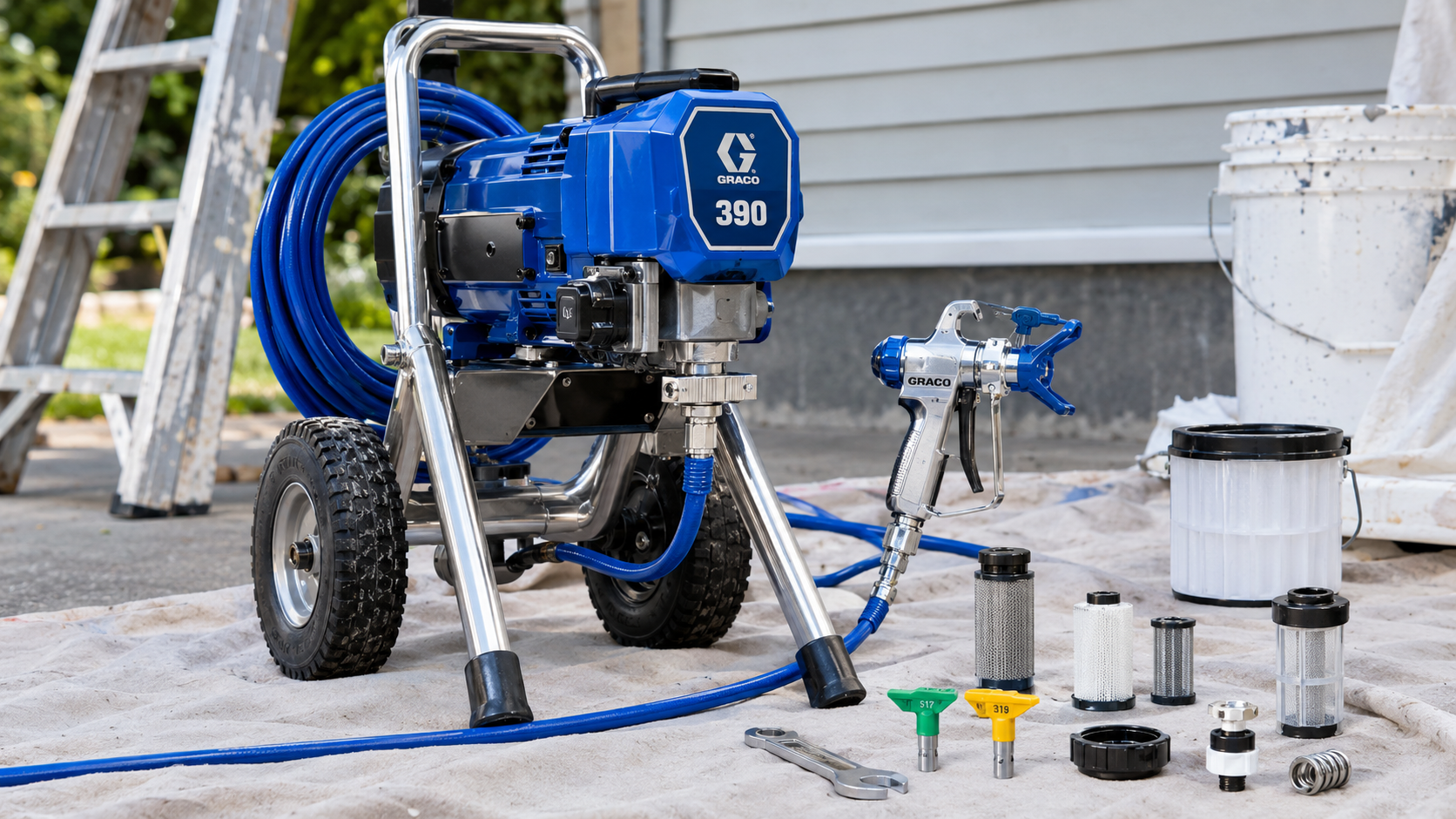
The 390 is one of the most common machines in American painting, and a large share of them are on their second or third owner. That means a lot of people are working on a 390 without the paperwork, without knowing which version they have, and without any sense of what has already been replaced.
This is a walkthrough for exactly that situation: what the machine is, what the variants are, what wears, and how to work out which parts apply to the one in front of you.
Where the 390 Sits
The 390 is an entry level contractor machine. That phrasing matters in both directions.
It is a contractor machine, meaning it is built to be rebuilt rather than discarded. The pump comes apart, the parts are available, and a well maintained 390 lasts a long time.
It is also entry level within that category, meaning it is the smallest of the proper contractor electrics. Output is modest compared to a 495 or a 595, and that sets a real ceiling on tip size and on how many guns it will support. Pushing past that ceiling is the most common way owners get into trouble with these machines.
For somebody doing residential repaints, interior work and small commercial jobs with one gun, it is a good fit. For somebody who has grown into larger commercial work, it becomes a machine that needs pumps more often than it should.
The Variants: Corded, Cordless, and Configuration
Here is where second hand buyers get caught. The 390 name covers more than one machine.
Corded 390 PC. The conventional version, plugged into a wall or a generator. Available in Stand and Hi-Boy configurations.
Cordless 390 PC. A battery powered version of the same basic machine. The fluid section is comparable but the power system is entirely different, which means the motor, control electronics and much of the frame hardware do not cross over. These also come in Stand and Hi-Boy.
ProConnect versions. Machines with the quick change pump mount, where the displacement pump lower releases without tools.
The practical implications:
If you have a cordless machine, a large share of the parts listings you find for a 390 do not apply to it. The pump and fluid path may match. The power and control side will not. The 390 PC cordless airless sprayer stand parts listings are separated out for this reason, and working from a corded machine’s breakdown will produce the wrong part on anything electrical.
If you have a ProConnect machine, the pump is a releasable lower rather than a bolted assembly, and the two are not interchangeable.
The Pump It Shares With Bigger Machines
One genuinely useful thing about the 390: the ProConnect pump lower fitted to these machines is shared with a range of larger sprayers in the same family, including the 395, 490, 495 and 595 variants.
That has two consequences worth knowing.
For a mixed fleet, one pump lower and one set of packing kits can cover several machines. If you run a 390 and a 495, you are servicing one fluid section rather than two. That is a real saving in both parts spend and in the attention required to keep the right spares on hand.
For a second hand buyer, parts availability on these pumps is excellent precisely because they are shared so widely. A machine that shares its wear parts with four other models is a safer used purchase than one with a unique fluid section.
The packing kits for this family cover the 390 through the 595, which is one of the broader coverage ranges in Graco’s electric lineup.
What Actually Wears
In the order you will meet them.
Tips
The highest frequency consumable and the most common cause of a complaint. A worn tip produces a pattern that will not fill out, sprays wider than it should, and uses more material than it should. Tips are cheap and they are the first thing to change when a pattern goes wrong.
Filters
Three positions: the inlet screen, the fluid filter at the machine, and the gun filter. All three are cheap, all three cause symptoms that look like pump problems when they clog, and all three should be checked before any expensive diagnosis.
Pump packings
The main scheduled wear item. The symptom is fluid weeping where the rod enters the pump. When you see that, rebuild it. A pump run on failed packings damages the rod and the cylinder, which turns a modest repair into a replacement.
Drain valve
Underrated as a failure point. When the drain valve stops sealing, the machine loses prime between uses, and the symptom reads as a pump fault. It is an inexpensive part and the test is simple: with the machine pressurized and the valve closed, nothing should be returning to the bucket.
Inlet ball and seat
Part of the prime circuit. A machine that will not pick up material, after you have cleared the inlet screen and checked for air leaks on the suction side, is usually telling you about the inlet check.
Pressure control and transducer
Electrical rather than mechanical. The symptom is pressure that does not respond properly to the control, or that wanders. Important: check the supply before the component. More on that below.
The Supply Problem That Masquerades as a Fault
This deserves its own section because it accounts for so many unnecessary parts orders.
These machines are sensitive to the quality of their electrical supply. Run one on an undersized extension cord, or on a generator that is marginal for the load, and you get symptoms that look like serious faults: the machine cuts out, pressure wanders, the control appears unresponsive.
Control boards have been replaced over this. So have motors.
Before diagnosing anything electrical on a 390, check two things. First, the generator rating if you are not on mains power. Second, the gauge and length of every extension cord in the chain. A long run of light cord drops voltage at the motor and the machine behaves exactly as though something inside it has failed.
This is free to check and it is the single highest value diagnostic step on these machines.
Buying One Used: What to Look At
If you are considering a second hand 390, these are the checks worth making before money changes hands.
Prime it with water. Does it pick up, build pressure, and hold it. This exercises most of the fluid section in two minutes.
Look for weeping at the pump throat. Any paint where the rod enters means packings. Not a dealbreaker, since it is a rebuild rather than a replacement, but it is a price negotiation.
Open the filter housing. What you find tells you how the previous owner treated the machine. Cured material in there means it was not flushed properly, which means the pump has been living in the same conditions.
Run the pressure control up and down. It should respond smoothly and hold where you set it.
Check the cord and plug. Damage here is common and it is also a clue about general care.
Find the model number and write it down. Including configuration and any series letter. You will need it for every part you ever order, and the label will not last forever.
Ask what has been replaced. An honest seller will tell you. A machine with a recent pump rebuild and fresh filters is worth more than one with an unknown history, and the difference is usually less than the cost of doing the work yourself.
A Sensible Spares Kit
For a 390 in regular service:
- Tips in your two or three common sizes
- Gun filters in your working mesh
- A fluid filter element
- An inlet screen
- A pump packing repair kit
- A drain valve assembly
That list is inexpensive, it covers the overwhelming majority of what stops these machines, and the packing kit covers several other machines in the family if you run them.
What is not on the list: motors, control boards, complete pumps. These fail rarely, they tie up money, and they are better sourced when needed. The broader 390 series paint sprayer parts range is organized by assembly, which makes it reasonably quick to find a specific component when one of those less common failures does happen.
Knowing When the Machine Is Not the Problem
The last thing worth saying about the 390 is the uncomfortable one.
If you find yourself replacing pumps on a 390 more often than feels reasonable, the machine may not be at fault. Ask what tip you are running and how many hours a week it works. A 390 asked to do 495 work will wear its fluid section fast, and no amount of parts spending changes that.
The honest answer in that situation is a bigger machine, not more frequent rebuilds. Working out which category you are in is worth doing before the next pump, because the cost of three unnecessary rebuilds is a meaningful fraction of the cost of the right machine.
For everyone else, which is most 390 owners, keeping the cheap consumables current and the supply adequate will keep one of these running for many years. They are good machines within their limits, and most of their reputation for trouble comes from being asked to work outside them.